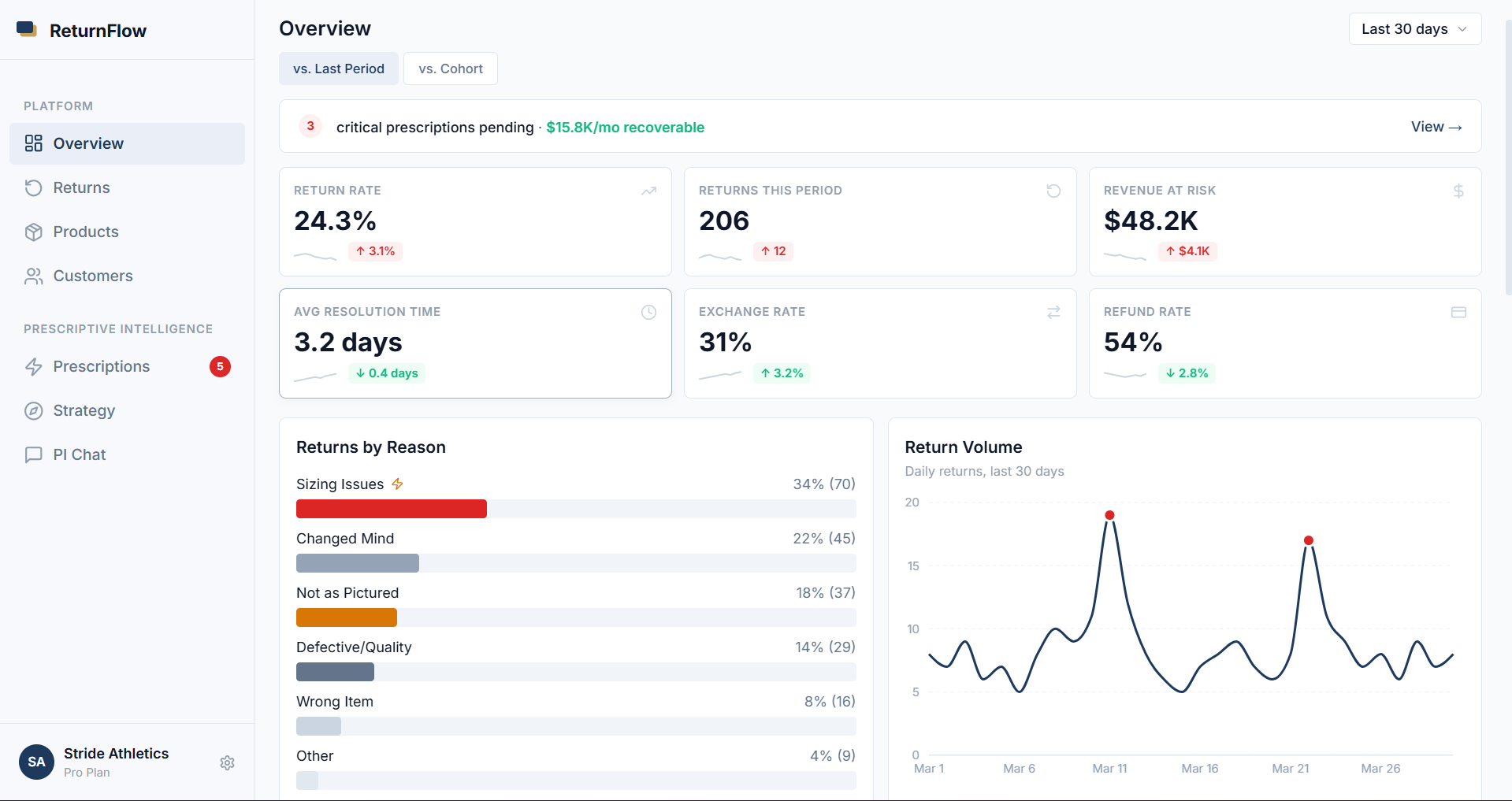
Every post-purchase platform shows the same screen.
Returns portals, tracking pages, analytics dashboards. 25+ platforms, hundreds of millions in funding. Swap the logo, and the merchant experience across all of them is identical.
Prescriptive Intelligence is a paradigm for building software that runs itself. A composable intelligence layer built on top of your existing platform.
It doesn't just show data. It diagnoses problems, compares against cohorts, and generates ranked recommendations your users can approve in one click.
We build it into your infrastructure. You own it completely.
It told them which way to go. SaaS today does the opposite. It hands users a dashboard full of data and says "good luck." It shows what happened yesterday. It rarely tells them what it means, or what to do about it tomorrow.
The endgame of SaaS is simple. Customers stop paying for software. They pay for results. Outcome as a Service (OaaS). Software that doesn't just inform decisions, but makes them. We won't get there in a single day. First came automations, software that did repetitive tasks faster than humans. Now come strategy tools, platforms that surface the right data so humans can decide better. Then comes OaaS, where the software decides and acts on its own. This is the forward march of SaaS.
The gap between data and decision is where all the value lives.That gap is yours to own.
AI-native startups are entering established verticals with $100M+ in funding. Enterprise suites are bundling your core differentiator for free. The players reshaping your category have already been capitalized. The window to respond is compressing.
Mid-market SaaS companies are being bought out by heavily funded competitors and Fortune 500s at unfavorable multiples. Fewer players remain in every vertical. The ones that survive have raised hundreds of millions. Anything below that is a point solution waiting to be absorbed.
Webinars, help docs, academy courses, Notion playbooks, lead magnets. All built to teach users how to extract value from the platform. CS teams spend 40% of their time doing the same thing, one ticket at a time. That level of hand-holding is the bottleneck.
SaaS multiples have compressed to 3 to 5x. Investors are asking harder questions about retention, expansion, and defensibility. "We have more features" or "we have AI" is no longer an answer.
Platforms ingest every signal needed to make a decision. They process all of it, render a dashboard, and stop. The human still has to interpret, decide, and execute. The bottleneck is not a missing feature.
None of them changed what the user actually does. Chatbots, AI autofill, the same features from 2022 repackaged as intelligence. Every dashboard now calls itself AI-powered. The user still clicks around, cross-references spreadsheets, and figures it out on their own.
Picture the opposite. The platform flags what's underperforming. Drafts the fix. The user doesn't analyze. They just click accept.
Every SaaS platform runs on three layers: frontend, backend, database. Prescriptive intelligence reads from all three, encodes domain expertise, and outputs the exact next action each user should take.
Data already lives inside the platform. Prescriptive intelligence connects it, applies domain logic, and produces one thing: the specific next step.
This is what prescriptive intelligence looks like when you build it into a real vertical. We start with post-purchase.
The pattern across every platform: merchants don't mention AI in reviews, on socials, anywhere. The intelligence is being built. It's not being felt.
Prescriptive Intelligence turns a returns management platform into a returns prevention platform. Closer to the outcome the merchant actually wants. Here's what that looks like across the full post-purchase lifecycle.
Returns portals, tracking pages, analytics dashboards. 25+ platforms, hundreds of millions in funding. Swap the logo, and the merchant experience across all of them is identical.
Sizing data, customer history, margin structures, cohort patterns. The platform has every signal it needs to act. Instead, it renders a dashboard, and the merchant is left to figure out what to do about it.
The system reads every signal the platform already collects, identifies the root cause humans miss, and surfaces a specific, ranked recommendation.
This is what happens when a returns management platform becomes a returns prevention platform. It prevents, prescribes, and learns. Autonomously.
Prescriptive Intelligence is a protocol, not a product. We implement it directly into existing infrastructure with components we have spent years developing. The code sits on client machines. The IP belongs to the client. There is nothing to renew.
Submit a platform URL. We will assess where prescriptions would create the most value and share what we find.